
Skin Effect, Joule Heating, and Why “More Current” Is Not Linear
Explore why conventional engineering intuition fails in fast-switching, high-current systems; how skin effect, transient currents, and temperature-dependent resistivity combine to make conductor heating nonlinear.
Vikram Kaushik
3/1/20264 min read
Skin Effect, Joule Heating, and Why “More Current” Is Not Linear
A copper busbar in a fast-switching power system developed progressive edge discoloration, surface microcracking, and eventual contact degradation. Electrical review confirmed that RMS current remained within rating, cross-sectional area was conservative, and steady-state thermal simulations predicted acceptable bulk temperature. No conventional design limit had been violated.
The discrepancy arose because the system had transitioned out of the steady-state regime implicitly assumed by the design model. In transient, high-edge-rate environments, increasing current amplitude does not merely scale losses. It alters current distribution, thermal gradients, and material response.
In the previous posts, we discussed how materials stop behaving ideally when fields intensify and time scales compress. This is where that story continues — inside the conductor itself.
The failure was not due to excessive average heating, but to a change in operating regime.
Classical Joule Heating Assumptions
Under DC or sufficiently low-frequency excitation, resistive heating follows the familiar quadratic relationship: total power dissipation equals the square of current multiplied by resistance. At the local scale, volumetric heat generation equals current density squared multiplied by electrical resistivity.
This formulation carries implicit assumptions:
Current density is spatially uniform.
Electrical resistivity is constant.
Resistance does not evolve during operation.
Thermal diffusion acts on a slower time scale than excitation.
Steady-state conditions are representative.
When these conditions hold, temperature rise scales predictably with current squared, and conductor sizing based on DC resistance is sufficient.
These assumptions break down once electromagnetic time scales approach geometric diffusion times.
Skin Effect and Current Redistribution
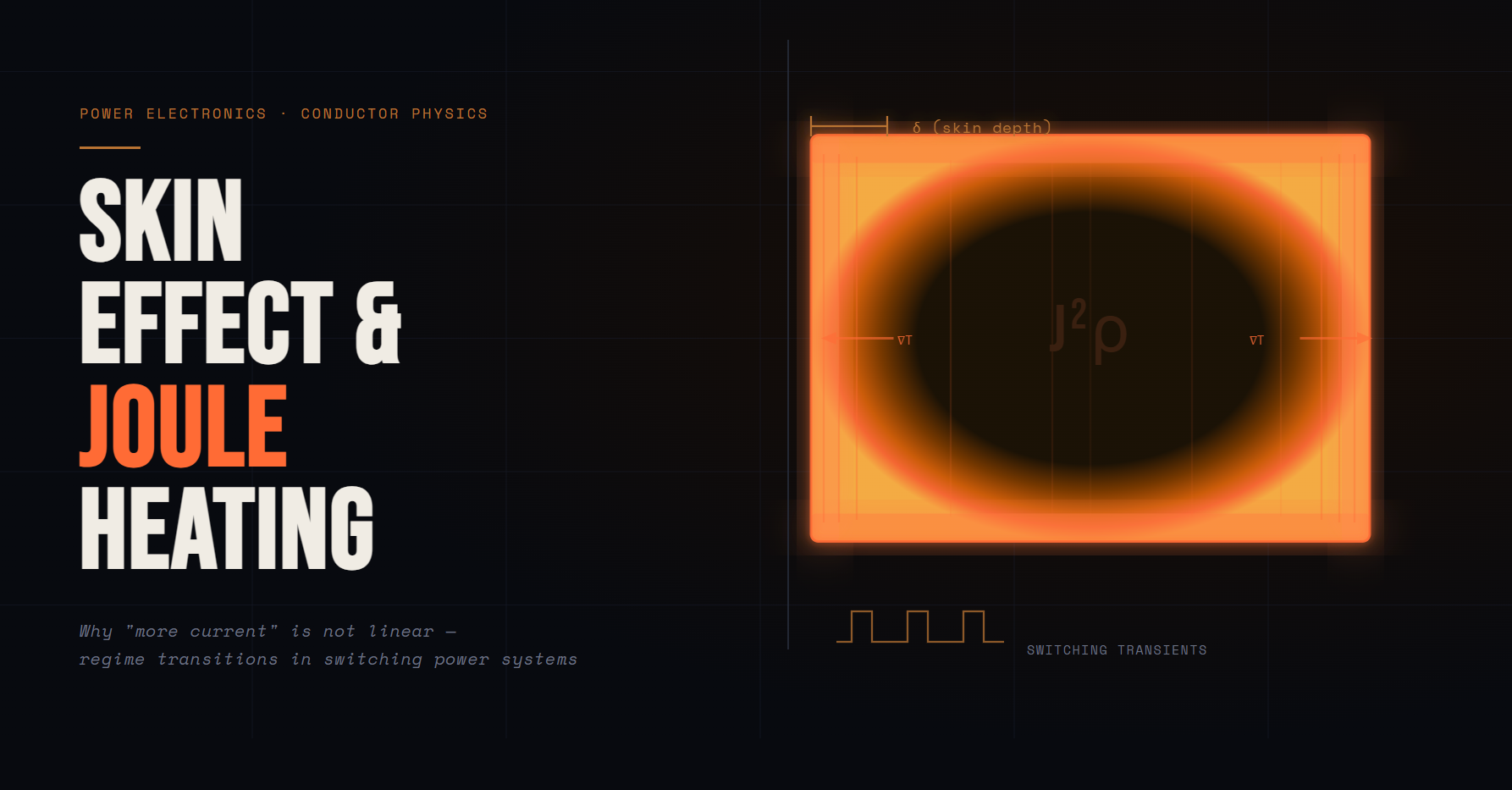
When current varies rapidly, the associated time-varying magnetic field induces internal fields that oppose penetration into the conductor interior. This produces the skin effect, in which current density is highest at the surface and decays approximately exponentially with depth.
The characteristic penetration distance, known as skin depth, decreases with increasing frequency, increasing magnetic permeability, and increasing electrical conductivity.
For copper, penetration is several millimeters at power frequency, sub-millimeter at tens of kilohertz, and on the order of tens of micrometers at megahertz frequencies.
At sufficiently high frequency, the effective conducting area is no longer the full cross-section. It is approximately the conductor perimeter multiplied by the skin depth. As skin depth decreases, effective area collapses while total current remains fixed. The result is a sharp increase in surface current density.
Since local heating scales with the square of current density, losses increase disproportionately relative to DC predictions. The conductor no longer behaves as a homogeneous resistive volume but as a spatially constrained current shell.
Transient Excitation and Electromagnetic Diffusion
In switching converters and pulsed systems, even nominally DC buses contain significant high-frequency components during transitions. Spectral content is governed primarily by rise time; nanosecond-scale edges correspond to megahertz-range frequency components.
A second critical parameter is electromagnetic diffusion time, which scales with magnetic permeability, electrical conductivity, and the square of the conductor thickness. This time represents how long it takes current to penetrate fully into the bulk.
If the pulse duration is shorter than the electromagnetic diffusion time, current cannot reach the interior before the excitation changes. The bulk remains electromagnetically underutilized while the surface layer carries a disproportionate share of current.
Thus, average current may appear modest, yet peak surface current density during switching events can be extreme.
Thermal Response Under Short Pulses
Temperature evolution is governed by the balance between volumetric heat generation and thermal diffusion. Heat generation depends on current density squared and resistivity, while thermal spreading depends on thermal conductivity, density, and heat capacity.
Under steady excitation, temperature gradients smooth out as diffusion redistributes energy. Under short pulses, energy deposition can occur faster than heat can diffuse. Surface temperature rises sharply while bulk temperature remains largely unchanged.
The consequence is steep thermal gradients confined to a thin surface layer. These gradients drive cyclic thermal expansion, interfacial shear stress, and localized plastic deformation. Because bulk sensors respond to averaged temperature, they often fail to capture these surface excursions.
Failure initiates at the surface long before steady-state limits are reached.
Temperature-Dependent Resistivity and Nonlinear Coupling
Copper resistivity increases approximately 0.39 percent per Kelvin. This introduces nonlinear coupling between electromagnetic and thermal behavior.
Surface current concentration raises local temperature. Elevated temperature increases local resistivity. Increased resistivity modifies local current distribution and amplifies resistive heating. Because heat generation depends on both current density and resistivity, this creates a positive feedback mechanism within the surface layer.
The conductor becomes a coupled electromagnetic–thermal system with state-dependent properties. In this regime, temperature rise is no longer proportional to current squared alone. It depends on frequency content, geometry, switching rate, and thermal time constants.
Small increases in peak current or reductions in rise time can produce disproportionately large increases in surface temperature, thermal gradient amplitude, and fatigue accumulation.
Why the Original Design Appeared Valid
The original design relied on DC resistance, uniform current density assumptions, steady-state thermal modeling, and bulk temperature limits. These models are appropriate within the low-frequency regime where diffusion processes are slow relative to excitation.
However, once switching time scales approach electromagnetic and thermal diffusion times, current distribution becomes dynamic, resistance becomes locally temperature-dependent, and heating becomes geometrically constrained to a thin surface region.
The governing physical laws remain unchanged. What changes is the hierarchy of time scales.
Regime Transition
Maxwell’s equations, Ohm’s law, and Fourier’s law remain fully valid. The observed behavior does not contradict classical theory. Instead, it reflects a transition from a bulk, steady-state regime to a transient, diffusion-limited regime.
When switching rise time becomes comparable to or shorter than electromagnetic diffusion time, the conductor ceases to behave as a uniform resistor. It behaves as a spatially evolving system in which current, temperature, and material properties interact dynamically.
Beyond that boundary, increasing current is not a linear scaling of loss. It is a shift into a different physical operating regime.
In that regime, reliability is governed by surface physics rather than RMS current.