
Why Two Identical Injection-Moulded Parts Can Fail Differently
Same mould. Same material. Same process parameters. One part survives its service load, the other cracks along a line nobody predicted. An analysis of causes.
Vikram Kaushik
7/6/20262 min read
Why Two Identical Injection-Moulded Parts Can Fail Differently
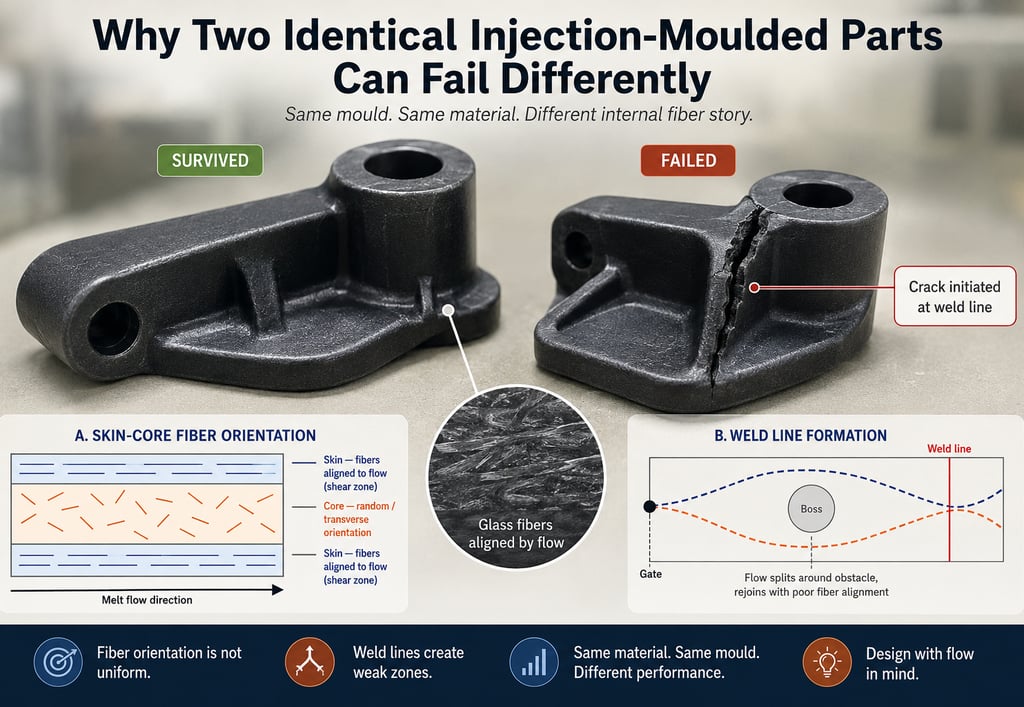
Same mould. Same material. Same process parameters. And yet one part survives its service load and the other cracks along a line nobody predicted.
The usual assumption in composite part design is that once you specify the fiber content — say, 30% glass-fiber-reinforced PP — you've specified the material's mechanical behaviour. You haven't. You've specified the ingredients. The actual mechanical performance depends on something far less visible: how the fibers oriented themselves as the melt flowed into the cavity, and that orientation is not uniform, not predictable by intuition alone, and not the same twice unless you control for it deliberately.
The Skin-Core Structure Nobody Talks About
When glass-fiber-reinforced polymer melt flows into a mould, it doesn't move as a uniform block. Near the mould walls, shear forces align fibers parallel to the flow direction — this becomes the "skin" layer. Toward the centre of the part thickness, shear is lower and fibers tend toward transverse or random orientation — the "core." This skin-core structure means a single injection-moulded part can have dramatically different stiffness and strength depending on exactly where and in which direction you load it, even though the material specification sheet lists one number for modulus.
This isn't a defect. It's physics. But it's routinely underestimated in early design work, where a single averaged material property gets pulled from a datasheet and applied uniformly across a CAD model that will, in reality, contain regions of dramatically different local stiffness.
Where Flow Paths Complicate Things Further
Complex part geometries force the melt to split and rejoin — around bosses, ribs, and cutouts. Where two flow fronts meet, you get a weld line: a region where fiber orientation is often poor, alignment is disrupted, and mechanical properties can drop by a significant margin compared to the surrounding material. Weld line location depends entirely on gate placement and part geometry — meaning two parts with slightly different gating strategies can have their weakest points in completely different places, despite using an identical material.
This is precisely why identical-looking parts, from an identical material, can fail differently under the same load. The failure isn't random. It's determined by a flow history that most design processes don't explicitly model.
Why CFD and Morphology Simulation Earn Their Cost
This is where coupling mould-fill simulation with fiber orientation prediction becomes valuable, rather than a nice-to-have. Simulating how the melt front advances, where shear rates are highest, and where flow fronts will meet allows fiber orientation — and therefore local mechanical properties — to be predicted before a single part is moulded. This lets weld lines be pushed toward low-stress regions through gate redesign, skin-core ratios to be anticipated rather than discovered through failure testing, and material property assumptions in downstream structural analysis to reflect the part's actual, non-uniform behaviour rather than a single averaged datasheet value.
The organisations that get this right treat fiber orientation as a design variable to be engineered, not a side effect to be tolerated. The ones that don't tend to find out the hard way — in the field, not in simulation.
The Broader Point
A material specification is not a performance guarantee. It's a starting condition. What happens between the hopper and the finished part — the flow history, the shear, the thermal gradients — determines what you actually end up holding. Treating a composite part's behaviour as fully described by its material datasheet is one of the more expensive assumptions in engineering, precisely because it's invisible until something fails.