
Why Your CAE Simulation Predicted Success, and the Part Still Failed
The report looked clean. Von Mises stress comfortably under yield, safety factor above 2, deflection within spec. The part didn't hold even when all the simulation predicted it would, and everyone in the room started asking the same question in different words: how did we miss this?
Vikram Kaushik
7/8/20264 min read
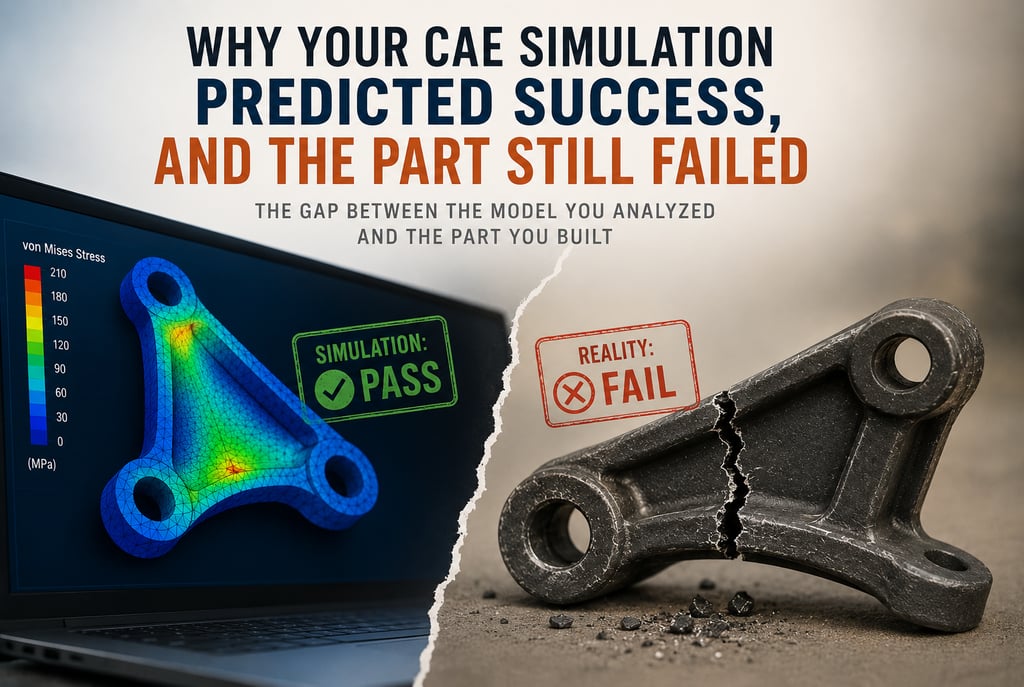

Why Your CAE Simulation Predicted Success, and the Part Still Failed
The report looked clean. Von Mises stress comfortably under yield, safety factor above 2, deflection within spec. The part didn't hold even when all the simulation predicted it would, and everyone in the room started asking the same question in different words: how did we miss this?
Nobody missed anything. The simulation did exactly what it was built to do; it answered the question it was actually asked, which is a narrower question than the one everyone assumed was being asked. That gap is where parts fail.
The model is not the part
A CAE model is a chain of translations: real geometry becomes a mesh, real material becomes a card of coefficients, real loading becomes a boundary condition, real manufacturing history becomes an assumption of "as designed." Each translation is a place where information gets discarded, not because anyone is careless, but because a model that kept everything wouldn't be a model. It's worth being precise about where the discarding happens, because each one fails differently.
Mesh sensitivity. A coarse mesh in a low-gradient region is fine. A coarse mesh at a fillet, a weld line, or a thickness transition, where stress concentrates over a distance smaller than the element size, isn't answering "what is the peak stress here," it's answering "what is the stress at this element's centroid, averaged over a region larger than the feature that matters." Run the same geometry at three mesh densities and watch the peak stress at the concentration keep climbing as elements shrink. If it hasn't converged, the number you reported wasn't a result, it was a snapshot of an unfinished calculation.
The material card is the biggest actor, and the least examined one. For a homogeneous isotropic material like a metal, a single stress-strain curve from a coupon test is a reasonable stand-in for the material everywhere in the part. For an injection-molded or fiber-filled polymer, that assumption is close to fiction. Fiber orientation isn't uniform through the part; it varies by wall thickness position, by distance from the gate, by flow front behavior at every rib and boss. A structural solver that takes a single "equivalent" material card, rather than a fiber-orientation tensor mapped from a filling simulation, is modeling a material that doesn't exist anywhere in the actual part. It exists in the gate region, or the core, or nowhere at all, depending on where you sampled the coupon that generated the card in the first place. The simulation isn't wrong. It's solving for a part with a single, spatially averaged material property, and reporting a stress result as if that part were the one on the shelf.
Boundary conditions are the analyst's opinion, formalized. "Fixed constraint" and "frictionless contact" are convenient idealizations of a bolted joint, a snap-fit, a press-fit bearing seat. Real clamping introduces preload and friction that redistribute load paths the idealized boundary condition never sees. A part that fails at the assumed-fixed interface, rather than at the geometric stress concentration the model flagged, is a boundary condition failure wearing a material failure's clothes.
Residual stress and processing history are usually absent entirely. An injection-molded part carries frozen-in stress from differential cooling and from the flow-induced fiber and molecular orientation locked in during solidification. A welded or heat-treated metal part carries residual stress from the thermal cycle. Unless someone explicitly imported that stress state as an initial condition, the structural model starts from zero stress, everywhere, at time zero. The part in your hand never started from zero.
Why this doesn't show up as "the model was wrong"
Each of these gaps produces a model that is internally consistent and produces a plausible-looking, converged, defensible number. That's what makes this failure mode dangerous: there's no error message. The post-processor doesn't flag "material card unrepresentative of local fiber orientation" or "boundary condition idealization discards preload." It reports a stress contour, a safety factor, and moves on. The analyst who ran the model correctly, using the inputs they were given, produced a correct answer to an incomplete question.
This is also why "just add more safety factor" is a weak fix. A safety factor absorbs uncertainty you can quantify. It does very little against a systematic gap, a material property that's wrong in the same direction everywhere the part sees peak load, because a systematic error doesn't get diluted by margin; it gets scaled by it.
What actually closes the gap
None of this argues against simulation. It argues for treating the simulation's output as conditional on inputs that need to be interrogated with the same rigor as the geometry.
Practically, that means: run a mesh convergence check at every stress concentration before trusting the peak value, not just the global displacement. For anisotropic or fiber-filled materials, couple a filling/orientation simulation to the structural solver rather than using a single averaged material card, particularly near gates, weld lines, and thickness transitions where orientation gradients are steepest. Treat boundary conditions as a hypothesis to be validated against instrumented physical testing where the joint or interface is load-critical, not as a modeling convenience. And where processing history is known to leave residual stress, either import it as an initial state or, at minimum, flag the result as a lower bound rather than a prediction.
The part that fails despite a passing simulation isn't evidence that simulation doesn't work. It's evidence that the simulation answered a real question, just not the one the part was actually going to face.